
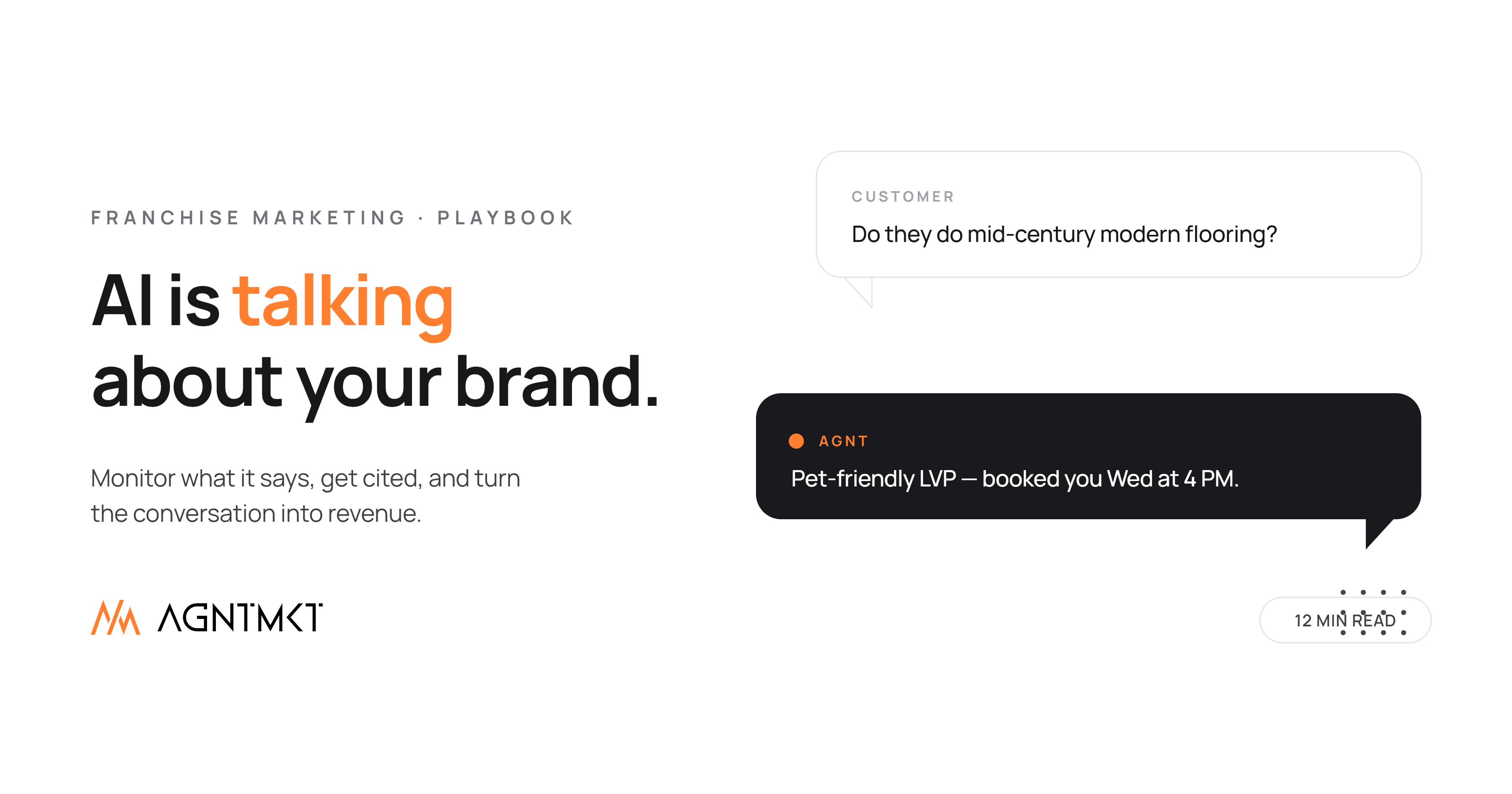
A few weeks ago I typed this into ChatGPT:
“Go to this Floor Coverings International, see if they do mid-century modern flooring, tell them about my two dogs — make sure that won’t be a problem — and if all is good, schedule a time for me next Tuesday or Wednesday between 3 and 5.”
Then I watched.
It set up a browser, opened the FCI website, found our chat agent, asked about mid-century modern flooring, told them about the dogs, and confirmed it was in fact pet-friendly — luxury vinyl plank that would hold up. It picked Wednesday at 4 PM, booked the consultation, and came back to me: “Your appointment for Wednesday, May 20 at 4:00 PM PDT has been confirmed at 16327 Main St, Granada Valley, CA.”
Two AIs negotiating a real consultation, on behalf of a real customer, at a real franchise location. I never touched the keyboard again.
That didn’t feel like a demo. It felt like a preview of where franchise marketing goes next — and the brands that aren’t ready for it are about to get quietly removed from a layer of commerce most franchise teams haven’t wrapped their heads around yet.
Three numbers to ground us
I’m not panicked about AI search, and you shouldn’t be either. But you should know exactly where the line has moved.
One — AI Overviews now appear in roughly 48% of Google searches as of early 2026, up 58% year over year (BrightEdge). Conductor’s 21.9-million-query benchmark pegs it lower at ~25%; Xponent21’s April sample puts the U.S. figure above 60%. Different methodologies, same direction. A year ago it was 13%. The screenshots your franchisees keep sending you are the result.
Two — AI referral traffic converts 4.4x higher than traditional organic (Semrush, 2026). Some studies go further — averi.ai’s 2026 benchmark shows AI search visitors converting at 14.2% versus organic’s 2.8%, a 5x premium. AI traffic is smaller. It’s also dramatically better.
Three — AI local visibility is up to 30x harder to win than traditional local search. SOCi’s 2026 Local Visibility Index analyzed 350,000+ locations across 2,751 multi-location brands. Only 1.2% of locations were recommended by ChatGPT, 11% by Gemini, 7.4% by Perplexity — versus 35.9% appearing in Google’s local 3-pack. In retail, only 45% of brands leading in traditional local search also showed up in AI results. That 55% gap is brands visible on Google but invisible to AI.
The game isn’t clicks anymore. It’s winning the citations that send the higher-converting clicks.
The framework: one customer, one conversation, two places it happens
Here’s the slide I’d put in front of every franchise marketing team.
Your customer is having an AI conversation. The only question is whether your brand is part of it.
That conversation happens in two places.
Offsite — on ChatGPT, Gemini, Perplexity, or inside a Google AI Overview. Someone else’s surface. Your brand is either cited there or it isn’t.
Onsite — when that same buyer leaves the AI and lands on your site. They arrive with conversational expectations. Your site either meets them in that mode or it doesn’t.
Most franchise teams aren’t doing either side well yet. The ones who are — with a system for both — are pulling away. Here’s how it plays out in the field.
Offsite: what AI monitoring actually exposes
Before AI, a franchise prospect did light research. Website, a few reviews, maybe a recommendation from a friend. A shallow but positive understanding was enough to walk into a location and buy.
AI changed that — not by making your brand harder to find, but by surfacing conversations about it that had always existed and been buried. Previous customers, happy and unhappy. The people who came in and didn’t buy. Those folks have detailed opinions: pricing pushback, doubts about whether the product solved their problem, comparisons to competitors. That used to be page five of Google. Now it’s the first AI Overview a new prospect reads.
When franchise brands finally turn on weekly monitoring — a defined prompt set run across ChatGPT, Google AI, and Perplexity — two truths tend to surface fast. Both uncomfortable.
You’re absent from the prompts that matter most. In the queries closest to your category and your buyer’s actual question, the established competitors dominate. Your brand barely registers. Nine times out of ten a buyer asks AI about the category, your brand isn’t in the room.
The narrative is being shaped by sources you don’t control. When you do show up, the citation breakdown is usually lopsided — overwhelmingly third-party sites you didn’t write (review sites, forums, blog posts), some competitor pages, and a small slice from your own domain. The story about your brand is being told by everyone except you.
Most monitoring programs die right there. Data sits in a dashboard, nobody acts, the contract gets cancelled in six months. The brands that make it work treat every signal as a directive — every weekly insight tied to a specific content or technical move:
- Absent from problem-specific prompts — the exact issues buyers are trying to solve → build net-new pillar pages structured around the prompts AI is actually fielding.
- AI pulling from third parties, not you → TLDR method on every article: a short, AI-pullable summary block up top, plus FAQ schema and structured data so LLMs can lift it cleanly. (Content with statistics, citations, and direct quotations earns 30–40% more visibility in AI responses, per Superlines’ 2026 benchmark.)
- Stale FAQs → full rewrites sourced from the actual prompt patterns monitoring surfaces, not a brainstorm.
- Pricing or category objections shaped by sticker-shock UGC → confront them head-on. A direct piece on whether the product is worth the cost, with the value framing buyers actually need.
- Authority concentrated on competitor sites → emerging-topic data feeds the PR and outreach calendar.
The loop matters more than any single action. Issue → solve → result, weekly, compounding. The pages getting cited in AI a quarter from now are the pages you build today in response to what monitoring just told you.
AI search isn’t a project you finish. It’s a discipline you run.
Onsite: AI didn’t just change where buyers ask. It changed how they ask.
This is the part most marketers haven’t internalized yet.
A few years ago, a customer with a problem went to Google with a general question. “My sink doesn’t work.” “I want new floors.” “Studio space for a hair stylist.” Google returned a list, and the buyer did the work of figuring out which results applied to their situation.
AI gave the buyer the language to ask the specific question — the one they were actually thinking. “Sink won’t drain after my kids flushed toilet paper — can someone come today?” “Floors that hold up to two crazy golden retrievers?” “Studio I can decorate to match my personal vibe?”
Every buyer has had a question that specific. They just couldn’t ask Google. AI finally gave them the way.
Now look at what most franchise sites still offer when that buyer lands. Nav menu. FAQ. Contact form. None of it answers a specific question. The FAQ doesn’t know about the golden retrievers. The schema doesn’t know about the toilet paper. The contact form doesn’t know about the vibe. Static responses, built for the old version of the buyer.
Here’s a real one. Floor Coverings International. A woman named Deborah opens with:
“I am looking to install leopard-print stair runner.”
That’s about as specific as it gets — and it’s not a query you type into Google and get a useful answer for. That’s a conversation.
What the agent did, with no human help:
- Explained FCI’s Mobile Showroom — samples come to your home, no store visit needed.
- Caught her assumption — “I can just go into their store” — and gently corrected it: FCI comes to you.
- Routed her by ZIP to the South Fort Myers location.
- Caught a wrinkle mid-conversation: “the address is for my client.” Deborah is an interior designer, sourcing for someone else. The agent confirmed she’d be on site too, so they could walk the stairs together.
- Booked the in-home consultation. Monday at noon.
22 messages. One booked appointment. Zero staff. A form can’t catch that her client’s address wasn’t hers. A scripted chatbot can’t either. Only a real conversation can.
Conversation IS the conversion mechanism
Most teams treat website chat as a way to deflect support tickets. The data says they have it backwards.
We pulled 12,000+ conversations across nine franchise brands over 90 days and plotted conversation length against conversion. The pattern is impossible to miss:
| Conversation depth | Type | Conversion rate |
|---|---|---|
| 1–2 messages | drive-by | <1% |
| 5–8 messages | engaged | ~8% |
| 9–15 messages | deep | 30%+ |
| 16+ messages | power user | 40–45% |
More conversation, more conversion. Linearly. Predictably. The longer someone talks to the agent, the more likely they are to book — the opposite of deflection. Your contact form doesn’t get more persuasive the longer someone stares at it. A conversation does.
And every one of those 12,000 conversations is also intent data — real questions and objections in the buyer’s own words. That feeds right back into the offsite playbook: which prompts to build content for, which objections to confront, which condition-specific pages to write. The loop compounds.
What I showed you at the start is already mainstream
Back to the FCI booking. Two AIs talking, one booked appointment. That’s not science fiction — it’s already a default feature.
OpenAI moved ChatGPT Agent from feature flag to default for Plus, Pro, and Team users in early 2026, then extended it to Business and Enterprise via Workspace Agents on May 5, 2026. ChatGPT now serves 900 million weekly users with Instant Checkout. Google launched agentic booking inside AI Mode for event tickets and beauty/wellness appointments in November 2025, and at I/O in May 2026 confirmed AI Mode has passed 1 billion monthly active users — with AI Overviews now serving 2.5 billion monthly.
The money on the table is real. McKinsey projects agentic commerce will drive $3–5 trillion globally by 2030. Morgan Stanley’s AlphaWise survey shows LLM adoption already near 50% in the U.S., with AI agents capturing 10–20% of e-commerce — between $190 and $385 billion. Forrester predicts 20% of B2B sellers will face agent-led quote negotiations by the end of 2026.
The future state of franchise marketing isn’t your customer talking to your agent. It’s your customer’s agent talking to yours — and reporting back. If your brand can’t have a conversation, if all your site offers is a form and a phone number, you’re invisible to that entire layer of commerce coming online right now.
Three things to do Monday
You don’t need new software for any of this. All three compound.
1. Monitor your brand inside AI — weekly. 10 to 20 priority prompts across ChatGPT, Perplexity, and Google AI Overviews. A spreadsheet and a recurring calendar invite get you 80% of the value. Tools like Scrunch, Profound, Otterly, and SE Ranking’s Visible get you the rest when you’re ready. The point isn’t the platform — it’s the discipline.
2. Get your AI-ready technical foundation in place across every location. Local Business schema per location. FAQ schema. AI crawlers unblocked in robots.txt — Cloudflare changed defaults last year and a lot of multi-location brands got shut off without realizing. Server-side render your content, not JavaScript-hidden. NAP consistency across listings. Unglamorous, and every other move depends on it. Remember the SOCi finding: AI rewards consistency across Google Maps, Yelp, Facebook, and your brand site — not strength in any single channel.
3. Build content that answers, not just ranks. Source from real AI prompts, not brainstorms. Lead with a 50–70 word direct answer — the TLDR method. Confront pricing and category objections head-on, not around them. Refresh quarterly: pages updated within two months earn 28% more AI citations than older content (Superlines).
The takeaway
Offsite gets you cited. Onsite makes your brand be the next conversation. And when agents start talking to agents — like that FCI booking — your chat agent is what makes your brand reachable at all.
The brands winning the next 12 to 18 months won’t be the ones with the loudest marketing. They’ll be the ones listening to the conversation AI is already having about their brand — and finding ways to join the next one.
Your customer is having an AI conversation. The only question is whether you’re in it.
See it work — on your own brand
Want to know what AI is saying about your brand right now? Ask our agent. It’ll pull your AI share-of-voice, show you where you’re cited and where you’re absent, and walk you through what to fix first — the same playbook we run for the brands above.
Talk to our agent → or reach us directly at will@agntmkt.ai.
AGNTMKT builds conversational AI for franchise brands. AGNTMKT has handled 12,000+ buyer conversations across 13 active client brands including Floor Coverings International, MassageLuXe, British Swim School, IV Nutrition, IMAGE Studios, and PuroClean.
Sources
BrightEdge, AI Overviews 12-month industry tracker (Feb 2025 – Feb 2026) · Conductor, Q1 2026 AI Overviews Benchmark (21.9M queries) · Semrush, AI Visitor Conversion Study 2026 · Similarweb, 2025 Zero-Click Search Study · Seer Interactive, AIO Organic CTR Update (Feb 2026) · SOCi, 2026 Local Visibility Index (350,000+ locations, 2,751 brands) · Superlines, AI Search Statistics 2026 · McKinsey & Co., Agentic Commerce Forecast to 2030 · Morgan Stanley AlphaWise, LLM Adoption Survey 2026 · Forrester, B2B Agentic Commerce Predictions 2026 · OpenAI, Introducing ChatGPT Agent (2025), Workspace Agents launch (May 2026) · Google, AI Mode Agentic Booking (Nov 2025), I/O 2026 Keynote (May 19, 2026)