
Pricing questions are almost never just about money. When a franchise executive asks “how much does an AI chatbot cost?” they’re actually asking: what am I getting for that number, is this going to work, and how does it compare to what I’m already spending to generate leads?
This guide answers all three — with real cost ranges, a breakdown of what drives pricing at the franchise level, a total cost of ownership framework, and an honest assessment of which tier fits which brand.
No bait-and-switch ranges. No “contact us for pricing” deflections. Just the actual numbers.
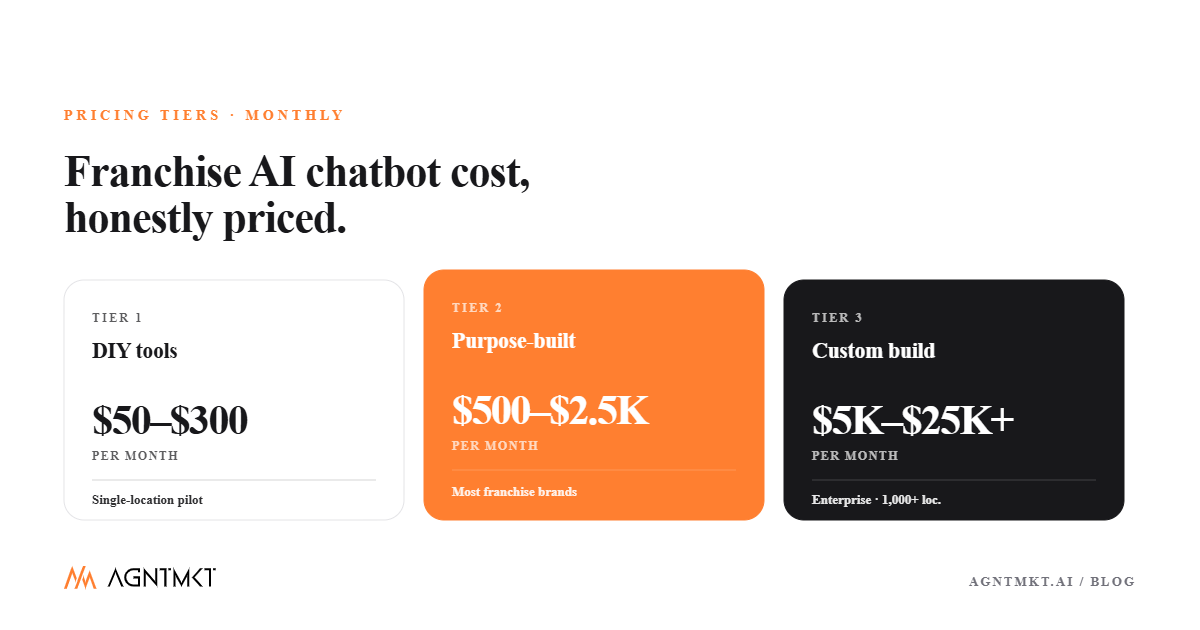
The three tiers of franchise AI chatbot pricing
Before diving into numbers, it’s worth understanding why franchise AI chatbot pricing is more complex than generic chatbot pricing. There are specific capabilities that franchise brands need — FDD compliance, multi-location routing, live location data, real-time lead scoring — that generic tools don’t provide. The pricing reflects that.
There are three tiers. Each has a different cost structure, a different capability ceiling, and a different ideal use case.
Tier 1: DIY / off-the-shelf chatbots
Monthly cost: $50–$300/month
Tools like Intercom (Starter), Tidio, Drift Starter, or Chatfuel fall into this category. You’re paying for a platform, not for franchise-specific configuration. You build the bot yourself using templates and visual editors.
What you get:
- A deployable chat widget
- Basic lead capture (name, email, phone)
- Simple FAQ automation
- Integration with common CRMs via Zapier or native connectors
What you don’t get:
- FDD compliance awareness — no guardrails against unauthorized earnings claims
- Multi-location routing — a single generic chatbot isn’t built to identify and route to 50+ territories
- Franchise-specific lead scoring
- After-hours escalation workflows tuned to franchise operations
- Any understanding of your brand, your vertical, or your franchise model
When it makes sense: A single-location pilot where compliance risk is low and you just want to test whether conversational engagement moves your metrics. At the brand or franchise development level, these tools are a liability. An agent that gives a legally problematic answer about ROI on a development site can cost significantly more than a year of proper platform fees.
Hidden costs to account for:
- Internal labor to build and maintain the bot (typically 5–15 hours/month)
- Developer time for CRM and routing integrations
- Ongoing QA to catch off-brand or legally risky responses
Tier 2: Franchise-purpose-built platforms
Monthly cost: $500–$2,500/month (depending on location count and features)
This is where purpose-built franchise AI platforms operate. The cost covers not just the technology but the configuration, compliance layer, multi-location infrastructure, CRM integration, and ongoing support.
What you get:
- Full onboarding and knowledge ingestion (FDD, website content, brand voice)
- FDD-compliant response architecture for development agents
- Multi-location routing with live location data
- Real-time lead capture with enriched records
- Lead scoring for franchise development
- CRM integration (HubSpot, Salesforce, Zoho, FranConnect)
- After-hours escalation workflows
- Analytics dashboard with conversation-level data
- Ongoing optimization and support
What drives cost within this tier:
| Driver | Cost impact |
|---|---|
| Number of active locations | Each additional location adds routing and data complexity |
| Consumer vs. development vs. both | Dual-agent deployments cost more than single-agent |
| CRM and scheduling integrations | Native integrations vs. custom API work |
| Custom lead scoring models | Scoring against your specific criteria adds configuration time |
| Multi-language support | Each language adds knowledge management overhead |
| Compliance complexity (FDD review) | Complex or frequently updated FDDs require more ingestion work |
When it makes sense: Any franchise brand with 10+ locations running a development program, a consumer-facing website, or both. This tier is where the ROI math starts to work convincingly. For consumer brands, incremental appointments captured in after-hours windows that were previously unconverted typically cover monthly platform cost within 30–60 days. For development brands, a single incremental closed deal covers multiple months of platform cost.
What a realistic contract looks like: Most franchise AI platform vendors price on a monthly subscription. Setup fees (one-time, covering onboarding and knowledge ingestion) range from $500–$2,000 depending on complexity. Monthly platform fees are typically fixed — you’re not billed per conversation or per lead, which makes cost predictable at scale.
Tier 3: Custom-built enterprise solutions
Monthly cost: $5,000–$25,000+/month (includes development retainer)
Some enterprise franchise brands — those with thousands of locations, proprietary CRM infrastructure, complex multilingual requirements, or regulated verticals — need a custom-built solution. This tier involves dedicated AI/ML engineers, bespoke integrations, and ongoing development capacity.
What you get:
- A fully owned AI system (not a SaaS platform)
- Custom model fine-tuning on your proprietary data
- Integration into legacy or proprietary CRM and scheduling systems
- Full data sovereignty (your infrastructure, your data)
- Dedicated engineering support
What the true cost looks like: Custom development isn’t just the monthly retainer. It’s the build time (typically 3–6 months before go-live), the ongoing maintenance burden (AI systems require continuous tuning), and the organizational overhead of managing a technical product. Total cost in year one for a full custom build often lands between $150,000–$400,000.
When it makes sense: Enterprise brands with 1,000+ locations, proprietary infrastructure that won’t integrate with SaaS tools, or compliance requirements that exceed platform capability. For most franchise brands — even those with hundreds of locations — Tier 2 covers the use case at a fraction of the cost.
Total cost of ownership: the full picture
Monthly platform fees are only one line in the TCO calculation. Here’s what a complete 12-month cost model looks like across tiers:
Tier 1 (DIY)
- Platform: $50–$300/month × 12 = $600–$3,600
- Internal labor (build + maintain): 10 hrs/month × $50–$100/hr × 12 = $6,000–$12,000
- Integration development: $2,000–$5,000 one-time
- 12-month TCO: $8,600–$20,600
Tier 2 (purpose-built platform)
- Platform: $800–$2,500/month × 12 = $9,600–$30,000
- Setup fee: $500–$2,000 one-time
- Internal labor (review + oversight): 2–3 hrs/month × $75/hr × 12 = $1,800–$2,700
- 12-month TCO: $11,900–$34,700
Tier 3 (custom)
- Build + retainer: $10,000–$25,000/month × 12 = $120,000–$300,000
- Infrastructure and hosting: $1,000–$5,000/month
- 12-month TCO: $150,000–$400,000+
The Tier 1 TCO number surprises most brands. The hidden labor cost of maintaining a DIY chatbot — building flows, monitoring for off-brand responses, manually updating location data, managing integrations — often exceeds the cost of a purpose-built platform. And you’re still left with a product that can’t handle FDD compliance or multi-location routing.
What moves the number: 5 pricing drivers
If you’re getting quotes from franchise AI chatbot vendors, these are the factors that will move the number up or down:
1. Location count. More territories mean more routing complexity, more location data to maintain, and more territory-specific lead records. Most platforms tier pricing by location count — 10 locations, 50 locations, and 200+ locations are materially different products.
2. Consumer vs. development vs. both. Running one agent is simpler than running two. A brand deploying both a consumer-facing agent and a franchise development agent needs two knowledge bases, two compliance frameworks, and two escalation workflows. Expect 40–70% higher cost for dual deployment vs. single.
3. CRM and scheduling integrations. Native integrations to common platforms (HubSpot, Salesforce, Calendly) are typically included or low-cost. Custom integrations to proprietary systems — specific booking platforms, bespoke scheduling infrastructure — add both setup cost and ongoing maintenance.
4. Custom functions and live data. The capability that separates good franchise AI from great franchise AI is real-time data access: live location lookups, real appointment availability, dynamic pricing, active promotions. Wiring these requires custom function development. It’s worth it — but it adds cost.
5. Language requirements. English-only deployments are standard. Spanish-language support is available from most franchise-focused platforms. Multilingual markets (Quebec, Latin America) add knowledge management and QA overhead per language.
The ROI denominator: what you’re getting back
A franchise AI chatbot that costs $1,500/month is only expensive if it doesn’t produce more than $1,500/month in value. Here’s how to think about it:
Consumer franchise brands: If your average service ticket is $1,500 and your close rate on inbound leads is 30%, each additional captured lead is worth roughly $450 in expected revenue. If the agent captures 10 additional leads per month from after-hours traffic that was previously unconverted, that’s $4,500/month in expected revenue against a $1,500 platform cost. 3:1 ROI before any efficiency gains. AGNTMKT client data suggests 20–40 daily chat interactions with 15%+ lead conversion rates are achievable — numbers that change the unit economics significantly.
Franchise development brands: A single incremental closed franchise deal generates $40,000–$80,000+ in franchise fees. At a 10% close rate on incremental qualified leads, you need 10 additional qualified conversations to close one deal. Franchise development AI deployments consistently deliver 50+ qualified lead conversations per month — making the math strongly positive within the first quarter.
See real franchise deployment results in the case studies section.
Which tier is right for your brand?
Choose Tier 1 if: You’re a single location or early-stage brand testing whether conversational engagement moves your metrics. Accept that you’re signing up for ongoing maintenance work and compliance limitations.
Choose Tier 2 if: You’re a growing franchise brand with 10+ locations, a franchise development program, or a consumer site generating meaningful traffic. You want FDD compliance, proper routing, real lead records, and a platform that handles the operational complexity — not a tool you have to babysit.
Choose Tier 3 if: You’re an enterprise brand with 1,000+ locations, proprietary infrastructure that won’t integrate with SaaS tools, or compliance requirements that exceed platform capability. Go in clear-eyed about year-one costs.
Next step
If your brand is at the evaluation stage — comparing vendors, building a business case, or trying to understand what “good” looks like — book a demo. We’ll show you a live deployment in your vertical and give you real numbers, not projections.
Related reading: The complete guide to AI chatbots for franchise businesses · How to cut franchise lead response time by 80%